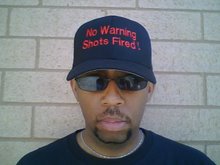
Claiming that Black people can't be racist, a controversial NC activist is calling for a redefinition of the word.
Paul Scott of Durham NC says that racism means that you have power to deprive others of their rights and that only applies to white people.
"The word "Racist" is racist in itself."
Scott says the usage of the word should be changed.
"Black people cannot be racist and I challenge any of those conservative talk show hosts to prove me wrong," says Scott
Scott has appeared on talk shows across the country on networks such as Fox News and MSNBC. He has been interviewed by newspapers such as The Wall Street Journal, USA Today, Christian Science Monitor and many others discussing Rap, Race and Religion.
For more information contact (919) 308-4233
website http://www.nowarningshotsfired.com
Showing posts with label police brutality. Show all posts
Showing posts with label police brutality. Show all posts
Monday, April 16, 2012
Wednesday, March 2, 2011
How Rodney King Changed Hip Hop
Rap, Riots and Rodney:
How Rodney King Changed Hip Hop
Paul Scott
March 3, 1991. What started off as just another case of a brotha gettin' beat down by the Po Po, would set off a chain of events that would forever change the socio-political dynamics of America, especially for the Hip Hop generation.
Although, the beating of Rodney King by four Los Angeles police officers happened 20 years ago, the shock waves from the event are still being felt today. To grasp the gravity of the situation one has to look at it in historical terms.
The period of the late 80's was,possibly,the most revolutionary since the '60's, as the combination of Reaganomics and racial incidents such as the Virginia Beach and Crown Heights incidents had pushed America, once again to the brink of revolution. There was also a cultural revolution happening ion America, where Black youth were rediscovering the works of heroes such as Malcolm X and Huey P. Newton. The rapidly maturing Hip Hop genre also began to absorb the changes as the party music of the early 80's began to become what Public Enemy front-man, Chuck D, coined "The CNN of Black America."
While the music previously was seen as fad and just a blip on the radar screen of middle America, the idea of rebelling "ghetto youth" using rap music as an unregulated form of information dissemination sent shock America's political foundation.
This is not the first time that the rising collective voice of "the silent minority" became a matter of national security.
According to the March 21, 1993 edition of the Memphis Commercial Appeal, in 1917, a Lt Col. Ralph Van Deman created the Army's black spy network, which snitched on black organizations, even black churches. The article names Robert Morton of Booker T. Washington's Tuskegee Institute and Joel Spingarn, one of the founders of the NAACP,as operatives in the spy network.
In the book, "Heard it Through the Grapevine," Patricia A. Turner wrote that "rumor clinics" were set up during World War II to "prevent potentially adverse hearsay of all sorts from gaining credibility."
Also, although the FBI's COINTELPRO is the best known of the "dirty trick" operations of the Civil Rights /Black Power Era, Clay Risen, in his book "A Nation On Fire: "America in the Wake of the King Assassination," wrote about the Army Operations Center and" its first operations plan for national disturbances, code named Steep Hill." Risen also talks about the U.S. Army Intelligence Command (USAINTC) which included 1000 agents "around tthe country whose job was to spy on militants and "monitor indicators of imminent violence."
The entertainment industry was not immune of the fear of a black uprising. In Peter Doggett's book, "There's a Riot Going On" he wrote about how James Brown was hired by the mayor of Boston , Kevin White, to throw a concert the night after the King murder to keep the natives calm.
From the very beginning it has been clear that America's fear was not the thugs in the street stealing hubcaps but the fear that they may become politicized, intelligent hoodlums. So on April 29, 1992, the day the police officers were acquitted of beating King, the apparatus was already in place to deal with young "urban" youth who were chanting Hip Hop lyrics challenging the system as their mantra.
As, rebellions took place in cities across the country, even the watchful eye of the Fed's underestimated the politicizing of the youth courtesy of rap lyrics. The site of "gangstas" articulating the political ideologies of Frantz Fanon on Night-line caught politicians with their pants down.
According, to the May 11, 1992 Time Magazine article "How TV failed to Get the Real Picture" it was reported that LA mayor Tom Bradley "requested" that in the midst of the chaos that the highly rated "Cosby Show:" air as an exercise in "crisis counter-programming." However, this was not 1986 and black youth were more responsive to the voices of the X-Clan, than they were "Dr. Heathcliff Huxtable."
So, another form of "crisis counter-programing" had to be developed that would insure that rebellions like what happened in LA would never happen again.
Even before the LA Rebellion, President George Bush had instituted the "Weed and Seed Program" which many residents of Los Angeles, such as those interviewed in the book "Uprisng" by Yusef Jah and Sister Shah Keyah considered a spy operation. The official purpose of weed and seed was to "weed" out gang members and in their places "seed"the hood with community programs.
So, we see the same strategy was used in Hip Hop as the biggest threat to this country's racial hegemony " conscious rappers" were weeded out and the industry was seeded with "gangsta" rappers.
One can clearly see how the careers of early conscious rappers suffered because of their courage to speak truth to power. However, the "gangster rappers" of the period became multi-millionaires and were rewarded with movie scripts and endorsement deals.
It is against this historical backdrop that two major post-LA Rebellion developments took place.
First the "no snitching" ethos was taken out of its historical context and was been replaced with a scapegoat for black on black violence and the demonization of entire black neighborhoods. Conveniently forgotten were the various government sponsored snitch operations that had plagued the black community for decades.h
More important is the overall anti-political direction of commercial Hip Hop, where, instead of "Cosby" crisis programming, the Hip Hop artists are now part of preemptive crisis programming, where the minds of the youth are distracted by such things as face tattoos This can help to explain, in part, why the incidents of police brutality in cities such as Cincinnati, New York, Oakland and Houston generated relatively little outcry.
Some may argue that times have changed and the season of "fighting the power" is a part of a bygone era.
However, with incidents of global outrage taking place from Egypt to Wisconsin, maybe not.
Perhaps Ice Cube was right when he once rapped ," April 29th brought power to the people, and we just might see a sequel."
Only the 'hood knows....
Paul Scott can be reached at (919) 451-8283 or info@nowarningshotsfired.com


Wednesday, July 29, 2009
NWSF Exclusive: Archer's Aim on Target
Archer's Aim on Target
Paul Scott
I don't know if you've seen the old HBO series, "The Wire" but it's about a neighborhood in Baltimore that even the cops are afraid to enter. There are real life 'hoods in Durham that remind you of that series. "The Bottom" is one of them.
If you aren't from Durham you probably only know the area by the names of the streets that often appear in newspapers because of drug arrests and murders, Enterprise St. and Scout Drive.
This is the area where Barry and Carmen Archer have decided to develop a youth program.
"Everywhere I've lived has been a hood," says Barry Archer who moved from Richmond, Indiana to Durham in 2006. While in Indiana, the Archers formed the award winning Barak Source for Learning, a program that focuses on diversity training, conflict resolution and community building.
Three years ago they moved their family of eight to Durham to not only be closer to family but they thought that they could be part of the solution to some of the city's problems.
In 2008, Barry says that he saw a lot of children walking aimlessly around the area of the Southside Community Center so he decided to volunteer to pilot a summer program. So this year, Barak Source for Learning teamed with three associates, Zayd Malik Shakur, Christopher Brown and Kevin Spencer and formed the Advanced Educational Program. They developed a summer curriculum based program at the center that ran from June 22-July 17.
The program served 30 children who showed up at 7:30 every morning just in time for a hot breakfast. Barry said that he asked the young men that hang out on the corner to help provide security for the children.
He also said that he brought in police officers to discuss such hot button issues as police brutality.
"It was an opportunity for the children to feel better about the police and the police to feel better about the children, said Carmen Archer.
"It removed the uniforms because uniforms are gang symbols, too," Barry added.
This is just the beginning for Barak Source for Learning as they will partner with other community organizations this fall to provide conflict resolution and other community services.
While so many people are throwing darts at Durham's youth, it's good to see the Archers are aiming in the right direction.
Barak Source for Learning can be reached at (919) 824-3627 or baraksourceforlearning@yahoo.com
Paul Scott writes for No Warning Shots Fired.com. He can be reached at (919) 451-8283
Friday, July 24, 2009
Obama's Solution for Race Relations: Let's all Get Drunk
Obamas Solution for Race Relations: Let's all Get Drunk
Paul Scott
It seems just like yesterday when black folks were cheering on President Obama for dissin' the cop, Sgt. James Crowley who allegedly assaulted Harvard Professor Henry "Skip" Gates.
(Wait a minute. It was yesterday.)
After all, as they say in the hood, you're supposed to ride for your homies when they get harassed by "the popo."
But not so fast.
Seems that as of today the Prez has done the reverse moonwalk in regards to his previous statement that the Cambridge police officers "acted stupidly," when they busted Dr. Skip for breaking into his own house.
Now, I didn't jump on the bandwagon with the folks who wear proclaiming Dr. Gates the official poster child for police brutality in the post racial Obama age. This very moment in some hood, somewhere, some brother is getting a Rodney King styled beat-down as you read this.
But I don't really see how Skinny Skip would pose a threat to anybody. (My 90 year old neighbor, Mrs. Jefferson can knock Gates out on a good day.)
But that's beside the point.
The point is President Obama was right the first time. It was stupid.
But now the Prez is saying that maybe he misspoke.
Now he's saying that Crowley is a "good guy," a real credit to the boys in blue, everywhere.
He also says that it is because of the past that African Americans are a little sensitive when it comes to matters like this.
Uh..no...We are "sensitive" because stuff like this is happening in the present.
President Obama is also inviting Crowley and the Skipmiser to the White House to crack a few brewskis.
So, I guess that's the Presidents solution to this countries "race problem."
Let's all go to the bar, get plastered and sing old Willie Nelson songs until we pass out.
And just think.
Fifty years ago, instead of marching through Alabama and getting sprayed by fire hoses and bitten by police dogs, all Dr. Martin Luther King and them had to do was invite Bull Connor over for a couple of 40ozs of Colt 45...
Well, in the words of that dude from the Bud Light commercials...
"Here's to you Mr. President, for your overly simplistic analysis of race relations.... "
"misteroverlysimplisticpresidentonracerelations "
Paul Scott writes for No Warning Shots Fired.com He can be reached at info@nowarningshotsfired.com (919) 451-8283
Subscribe to:
Posts (Atom)